Girl
A Mutable Instruments Elements based modal synthesis voice for the Ksoloti Big Genes hardware.
Sequence it with Strudel.
Overview
Girl is a modal-synthesis voice — a physical-modelling resonator — running on Ksoloti Big Genes hardware. It’s based on Mutable Instruments Elements by Émilie Gillet, and named, like everything here, after the nursery rhyme: three for a girl. Not affiliated with, or endorsed by, Mutable Instruments.
Running Elements on Ksoloti
Elements is one of the most demanding things Mutable made — its resonator can pin a processor on its own. It is a bank of tuned filters, and how many of them you run is the single biggest thing you can spend CPU on. Mutable run 52. Girl runs 40 - a number derived by experiment. 52 and 48 dropped out on this board; 44 ran clean, and 40 is 44 with margin. We trade a little of the original’s ceiling for a build that simply runs on the hardware.
Signal flow, and where the controls sit
Three Exciters — bow, blow and strike — are summed and fed into the Resonator, then into Space. Each exciter owns one pot, with S4 used to cycle between: level, meta, and timbre, the order Elements uses across its own panel. Space is one knob doing three jobs as you turn it up: dry bleed, then stereo spread, then reverb.
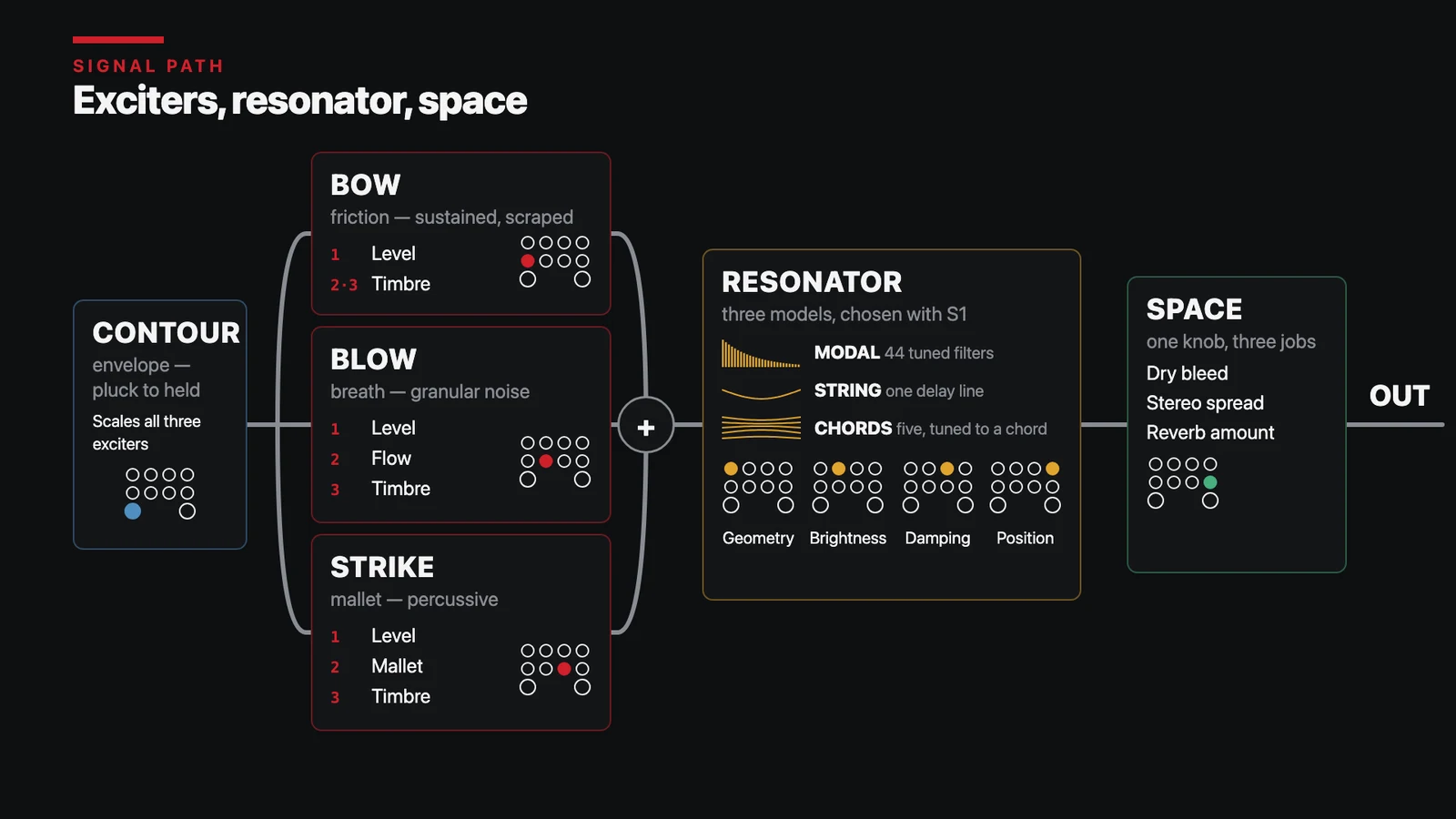
Everything the diagram doesn’t cover:
| Control | |
|---|---|
| Gate | CV-D — voltage also sets strength |
| Pitch | CV-X — 1V/oct, centred on middle C |
| Model | S1 — modal, string, chords |
| Play | S3 — manual gate, no patching needed |
| Resonator CV | P1–P4, summed with the pots |
| Assignable CV | A, B, C — S2 selects, E2 assigns |
| FM | CV-Y — ±49.5 semitones; attenuate at the source |
Pin map, CV targets and full behaviour are in the repo docs.
It’s firmware, not a Patcher patch
Girl is not loaded through the Ksoloti Patcher as a live patch. It’s flashed as firmware — you upload the .bin to the board — so it boots straight into the voice with nothing to open, compile or run in the Patcher. Flashing steps are below.
Flash it — no compiler needed
You need the .bin above and one free tool — dfu-util. No coding, no Patcher, no build environment.
- Download girl.bin above.
- Install dfu-util — on a Mac: brew install dfu-util. (Windows: dfu-util.sourceforge.net, add it to PATH. Linux: sudo apt install dfu-util.)
- Put the Big Genes in DFU mode: unplug the USB-C cable from the prog socket, hold the E1/S1 encoder button in (push the left encoder shaft), plug USB-C back into prog while still holding, then release.
- The screen and LEDs will stay off — that is normal, it means you are in DFU mode. Your computer should now see a DFU device.
- Run the command below in a terminal, from wherever girl.bin is.
- When it says “File downloaded successfully” the module restarts into Girl. The top line of the OLED should read “S1:Mod”.
dfu-util -d 0483:df11 -a 0 -s 0x08000000:leave -D girl.binUpdated May 2026