Secret
A chaotic oscillator for the Alchemy Lab — twelve strange attractors, with V/oct and one knob from free chaos to a locked note.
 Video coming soon
Sequence it with Strudel.
Overview
Secret is a chaotic oscillator. It runs strange attractors — sets of equations that never quite repeat — fast enough to hear, and plays them from a V/oct input like any other voice.
The problem with a chaotic oscillator is the word oscillator. Left alone, most of these systems have no pitch at all, or drift as you turn the knobs. Secret’s answer is one control, TAME. At zero the attractor runs free. Turn it up and the module pulls the attractor towards the note — gently at first, so it locks to the pitch but keeps its grit, then all the way to a clean, periodic tone. The interesting part is the middle.
It runs on the Hermetic Modular Alchemy Lab, an open DSP platform with a Daisy inside, six knobs with LED rings, three buttons and six CV jacks.
Named — like everything here — after the nursery rhyme: seven for a secret, never to be told. A system that is completely determined, and still can’t be predicted. Not affiliated with, or endorsed by, Hermetic Modular.
Tame — from noise to a note
The twelve systems fall into three families, and each needs taming differently:
- Spirals (Rössler and its relatives) already turn at a nearly steady rate. A small drive at the note’s frequency locks them, and the chaos survives the lock.
- Driven systems (Duffing, the pendulum) follow their drive. The drive is the note — and where they go chaotic, they fall onto subharmonics: a twelfth, or two octaves and a third, below it.
- Wild ones (Lorenz, Chua) ignore any drive. These get pulled back to a stored point on the attractor once every cycle, so the pitch is imposed but everything inside each cycle stays as rough as it was.
B2 chooses how TAME works: Auto uses each model’s own choice, or force Force or Sync on any model to hear the difference.
Twelve models
B1 steps through all twelve. Both its LEDs show the current model’s colour.
| First six | Second six | ||
|---|---|---|---|
| orange | Rössler | red | Driven pendulum |
| yellow | Van der Pol | cyan | Lorenz–Lü–Chen |
| blue | Lorenz | violet | Moore–Spiegel |
| magenta | Chua | lime | Forced Brusselator |
| green | Duffing | pink | Chaotic Colpitts |
| white | Coupled Rössler | teal | Hindmarsh–Rose |
The first six came from the Teensy. The second six were picked by ear from nine measured candidates — and none of them, as far as I could find, has been played as a V/oct voice in Eurorack hardware before.
Controls
| Control | Job | Control | Job |
|---|---|---|---|
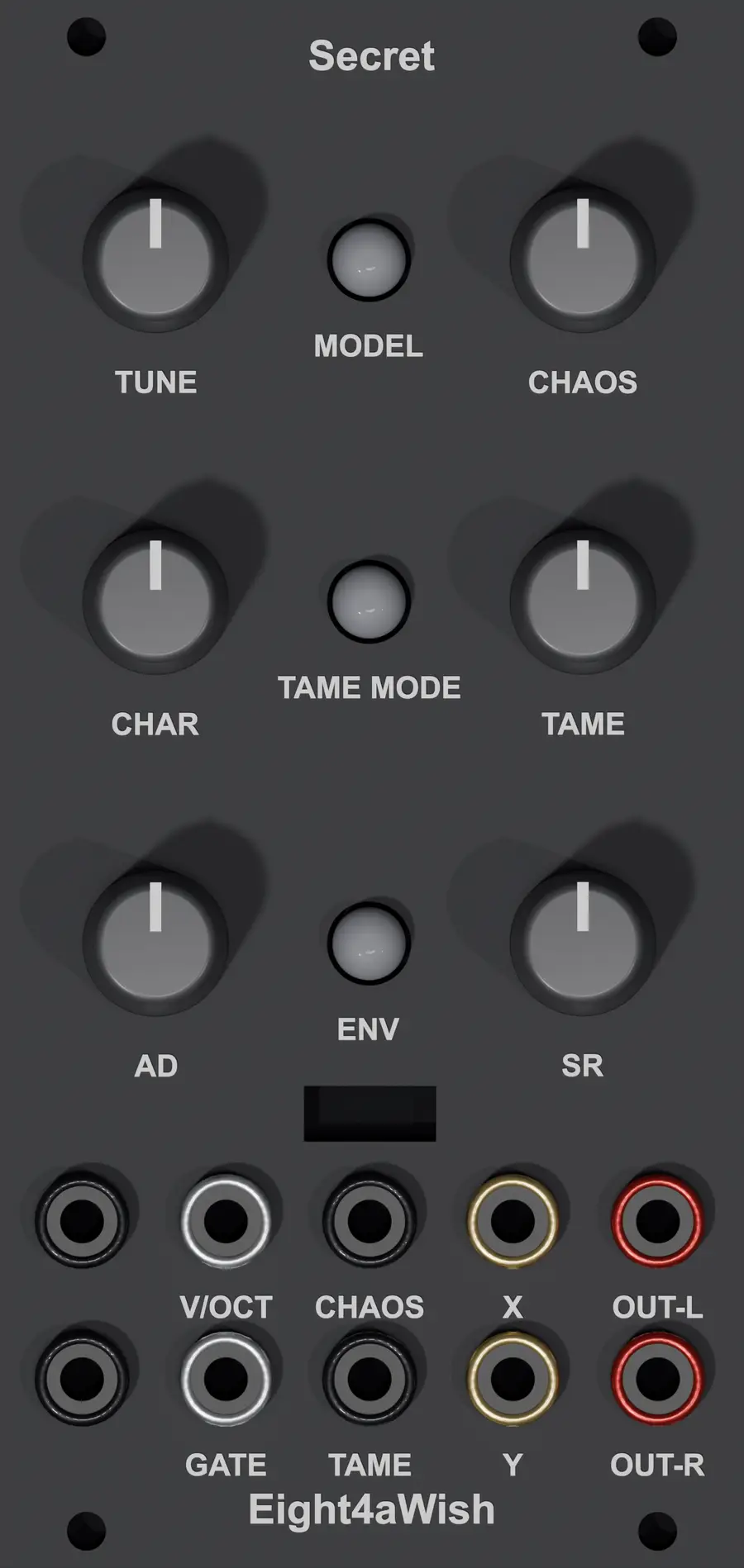
| TUNE | 27.5–880 Hz, plus V/oct on J3 | CHAOS | the main parameter — how chaotic; plus CV on J5 |
| CHAR | the second parameter — the character within it | TAME | free chaos (0) to a locked note (1); plus CV on J6 |
| AD | envelope attack and decay | SR | envelope sustain and release |
| B1 | model | B2 | TAME mode: Auto, Force or Sync |
| B3 | Drone (always open) or Gated by J4 |
| In | Job | Out | Job |
|---|---|---|---|
| J3 | V/oct | J7 | X CV — the raw attractor, for a scope |
| J4 | gate: in Gated mode it opens the envelope and restarts the attractor | J8 | Y CV |
| J5 | CHAOS CV, ±5 V across the knob’s travel | J9 | audio L (X) |
| J6 | TAME CV, ±5 V across the knob’s travel | J10 | audio R (Y) |
The rings show each knob plus its CV.
Seeing it
Patch J7/J8 into an X/Y scope and you see the shape the sound is making: Rössler’s spiral, Lorenz’s butterfly, Chua’s double scroll. It is also the best tuning aid there is — a locked note draws a figure that stands still, and a slipping one turns.
Known limits
- Four models top out inside the playing range at mid settings — Hindmarsh–Rose around 200 Hz, Chua 410, Colpitts 570 and Moore–Spiegel 730. Above that the note stops rising rather than the module overloading.
- V/oct uses the board’s own calibration, which sets each jack’s zero but not its scale.
- CV is read at 1 kHz, so there is no audio-rate FM.
- No presets. The button choices reset at power-on.
Provenance
Joranalogue’s Orbit 3 is an analogue double scroll with V/oct and a tame/wild switch, and there is a long line of attractors as slow CV. What I have not found anywhere is TAME as one continuous control that ends with the attractor itself locked to the note.
Built on Hermetic Modular’s MIT-licensed Alchemy SDK and Electrosmith’s libDaisy. Secret itself is MIT. Thanks to Luke Pendergrass at Hermetic Modular for the Alchemy SDK.
Flash it — no compiler needed
The Alchemy Lab ships with Hermetic Modular's own bootloader, so there is nothing to install first and no SD card involved. The firmware goes on over the front-panel USB-C from a web page. No compiler needed.
- Download the .bin above.
- Connect the Alchemy Lab's front-panel USB-C to your computer.
- Power on while holding B3. The rings spin a warm-white comet, then breathe slowly: the module is waiting for firmware.
- Open the Hermetic Modular Web Programmer and load the .bin.
- When it finishes, power-cycle. B1's LED lights orange — Rössler, the first model.
Updated October 2026