Mirth (filters)
Two filters from my rack, a Doepfer Wasp and a Behringer Swords, as neural networks with cutoff and resonance as knobs, on a Daisy patch.Init().
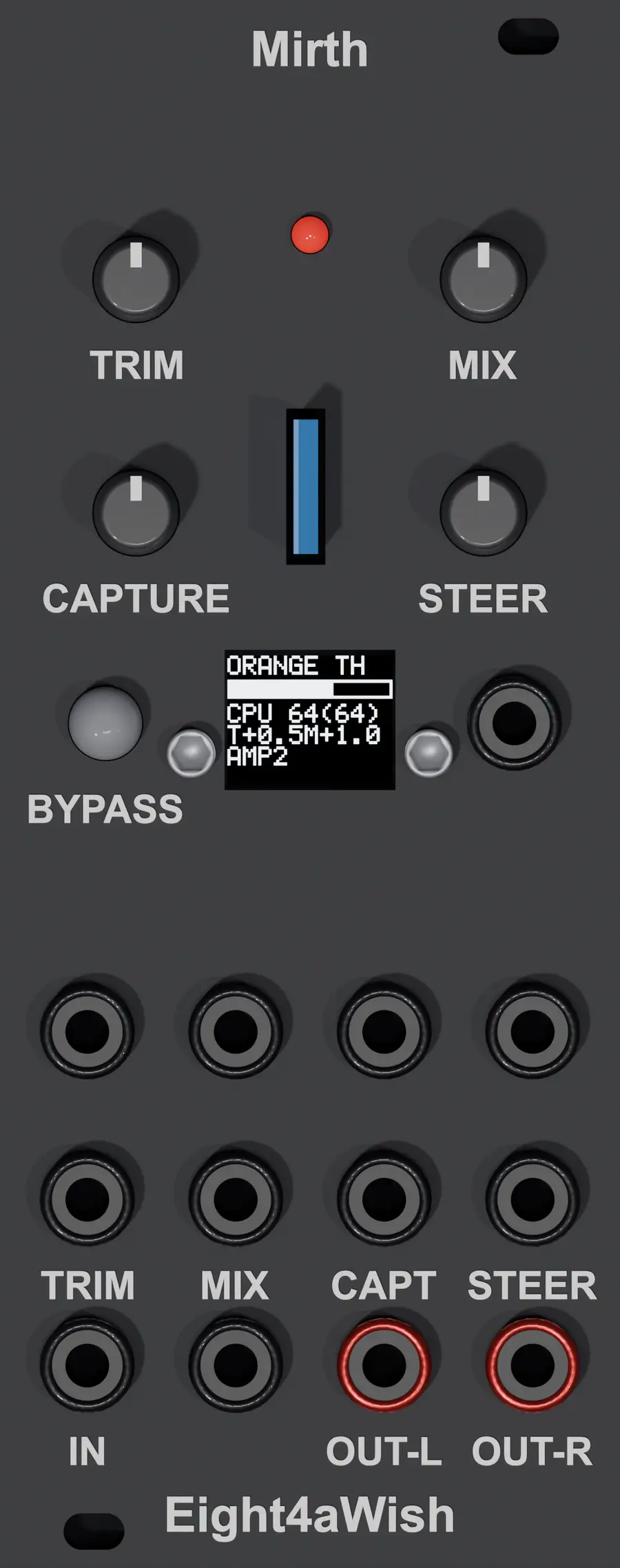 Video coming soon
Sequence it with Strudel.
Overview
Mirth plays neural networks on a Daisy patch.Init(). Mirth (amps) covers its first two banks, AMPS and NOT-AMPS: NAM’s A2-Lite captures, the same kind people share by the thousand for guitar amps and pedals. Every capture I could find was an amp or a pedal. I wanted something from my own rack.
So the third bank, FILTERS, plays two of my filters: a Doepfer A-124 Wasp and a Behringer Swords, each learned from recordings of the real module. This page is how they were made, and how to play them.
The Wasp is Doepfer’s take on the filter from the EDP Wasp, the late-70s synth whose filter uses CMOS logic chips as amplifiers. That is where its dirt comes from, and dirt is what makes a module worth capturing. It also has a property that turned out to shape everything: only the cutoff is under CV. Resonance is a knob.
The seven filters
| Screen | The filter | FREQ | RES |
|---|---|---|---|
FLT1 |
the Wasp’s low-pass at one setting, as an amp-style capture | — | — |
FLT2 |
the Wasp’s low-pass, learned at one resonance | cutoff | feedback from 9 |
FLT3 |
the Wasp’s low-pass, cutoff and resonance | cutoff | resonance |
FLT4 |
FLT3 with the Wasp’s own unpredictability above Res 8, as a granular layer | cutoff | resonance |
FLT5 |
the Wasp’s high-pass | cutoff | resonance |
FLT6 |
Swords, cutoff and resonance | cutoff, V/oct | resonance |
FLT7 |
FLT6 with Swords’ self-oscillation added | cutoff, V/oct | resonance; oscillates from 10 |
Controls
The same knobs as the other banks. Each knob is summed with the CV jack under it.
| Control | FILTERS |
|---|---|
| CV_1 (+ CV_5) | MIX, dry to wet |
| CV_2 (+ CV_6) | FREQ, the cutoff; the jack adds its volts, as on the real filter |
| CV_3 (+ CV_7) | RES, 0 to 11 |
| CV_4 (+ CV_8) | DRIVE into the network, −20 to +20 dB, unity at noon |
| B7 short | the next filter |
| B7 held 1.5 s | the next bank: AMPS → NOT-AMPS → FILTERS |
Audio in on IN_L; the same mixed signal on both outputs. On Mirth the screen shows the cutoff in volts and the Res dial; on Mirth Lite the LED flickers three times for FILTERS, then blinks the filter’s number. The full controls for both builds are on Mirth (amps).
A2 first, and why it is not enough
NAM’s easy trainer only accepts its own input file. To my ear it is a guitar riff sped up and repitched, veering into synth territory. So I recorded that file through the Wasp at one setting (Res 6, the cutoff held at +5 V) and trained an A2-Lite capture of it. It is on the card as FLT1.
The score here is ESR, error-to-signal ratio: the share of the real Wasp’s output the network fails to reproduce. NAM’s grades are under 0.01 great, under 0.035 not bad and under 0.1 might sound ok.
On NAM’s own validation passage, A2-Lite scored 0.048. On a synth riff it never trained on, two detuned saws at the same setting, it scored 0.105. NAM’s file does not drive the Wasp the way a sustained oscillator does. And an A2 has no knob: it is one setting, frozen. FREQ and RES do nothing on FLT1.
The riff, 4 seconds, Res 6, cutoff held at +5 V:
Real Wasp
A2-Lite, ESR 0.105
A GRU with the cutoff as a knob (below), ESR 0.008
Recording the Wasp
An Expert Sleepers ES-10 on my audio interface plays audio and a cutoff CV into the Wasp and records its outputs, with a loopback cable so every take lines up to the sample. Because resonance is a knob, I recorded a session at each of the eleven marks on the Res dial, sweeping the cutoff by CV inside each take: about four minutes of synth material per mark, for low-pass and again for high-pass. Res 5 was recorded and then kept back, so there would be a test of whether a network can fill in a setting it never heard.
A network with knobs
A GRU, a gated recurrent unit, reads the audio one sample at a time and carries a small history forward: 16 numbers, updated every sample, with learned gates deciding what to keep. The cutoff CV and the Res position go in alongside the audio, so the history depends on them too. That is 1,025 parameters, against A2-Lite’s 1,871.
I trained a larger size too, 24 numbers of history and 2,113 parameters. On the Daisy it needs 10,330 processor cycles a sample, against a budget of 10,000, so the module runs the 16s. The clips on this page come from the 24s, which score a little better (0.012 against 0.017 at Res 6).
The first version was badly designed, and it is worth saying how
To compare A2 with a GRU, I first trained a set of GRUs on the same NAM take. On NAM’s passage they scored around 0.001, forty times better than A2, and I nearly believed it. On the synth riff they fell to between 0.05 and 0.25, and the ranking changed completely. Every network had been chosen on a quiet nine-second passage of guitar-like plucks, which told me almost nothing about synth material. My family could not tell the best of them from the real Wasp on the riff, which says something about ESR too.
So I started again from the question. Train on synth material: about 31 minutes of sweeps across the ten trained Res marks. Choose each network on synth material spread through every take, at its beginning, middle and end, in case the Wasp drifts as it warms. Test once, at the end, on a riff no network trained on. And train every design several times from different random starts, so a lucky run cannot pass for a better design.
What it learned
The cutoff, in every run. With the cutoff alone at Res 6, the riff scored 0.012, and the same 4 seconds A2-Lite scored 0.105 on scored 0.008.
Real Wasp, Res 6, the cutoff stepping from 2 to 10 V
The cutoff as a knob, ESR 0.010
Leftover: the real Wasp minus the network, at the same gain
With cutoff and resonance, one network across the whole dial. ESR on the held-out riff, the average of three training runs of the 16 that went on the card:
| Res | 0 | 1 | 2 | 3 | 4 | 5 | 6 | 7 | 8 | 9 | 10 |
|---|---|---|---|---|---|---|---|---|---|---|---|
| ESR | 0.014 | 0.014 | 0.009 | 0.011 | 0.020 | 0.031 | 0.067 | 0.17 | 0.30 | 0.51 | 0.72 |
The bold one is the setting it never heard. It lands between its neighbours, so one network fills the gap in the resonance dial.
Real Wasp, Res 5
Cutoff and resonance, never trained at Res 5, ESR 0.047
Leftover
Then I played it on the module, and Res did almost nothing. The cutoff worked perfectly. Measured, at a cutoff of 6 V, the real Wasp grows by 8 to 18 dB across the spectrum from Res 6 to 10; the network fell by 2 to 4 dB. ESR counts the phase of every wiggle, which the ear ignores, so a network can keep its score low while getting the control wrong. Nothing in my tests had checked that the knob does what the real knob does. Now they do.
The network keeps pace with the Wasp’s resonance up to Res 7, then falls behind. So on the module the dial lifts its Res input above 7, and from 9 feeds the network’s output back into its input. RES goes to 11: from 10 it rings and holds a tone of its own, which the real Wasp never does.
The Wasp never does the same thing twice
At high resonance the Wasp goes wild. I recorded the same input four times at each of Res 6 to 10. Up to Res 7 the takes match each other almost exactly (ESR 0.0015 between them). At 8 they start to part (0.073), and from 9, at and above the cutoff, the difference between takes is most of what there is.
A network trained to get as close as possible to every sample cannot predict which way the next wiggle goes, so the closest it can get is the average of the possibilities. That is tamer than any of them.
Real Wasp, Res 10
Cutoff and resonance, ESR 0.64
Leftover
Borrowing the misbehaviour back
So the network plays the average Wasp, and the wildness goes back on top, taken from the recordings. No sound is added. The four takes give a record of how each one lifts and dips against their average, band by band, measured at each distance from the cutoff. On the module, grains of that record, about 117 ms each, drawn at random, boost and cut the network’s output at the same distance from wherever the cutoff is now.
I chose the settings by ear, over three rounds of listening: gentler grains cured a digital edge the first ones had. The layer fades in from Res 8 to 9, where the Wasp stops repeating itself, and there is no knob for it. That is FLT4: FLT3’s network with the layer.
It is not a perfect copy of the Wasp, but it has some of its own character, and that is audibly interesting: a beating in the mid-range, and at a low cutoff a rumble that sounds as if it is coming from a cave.
The first build glitched. I had estimated what the layer would cost instead of measuring it, and its worst moments came in at 2.7 times the estimate. Spread over ten blocks of audio instead of three, it fits: 70% of the processor, and at its busiest about 8,600 cycles a sample of the 10,000. It runs 54 ms late to make room for its grains, and the dry side is delayed to match, so MIX stays in time.
Swords: the same question, with Res under CV
On the Wasp every Res mark was a separate session, set by hand. Maybe that was why the networks learned Res weakly. On Swords, Res is under CV, so I recorded an hour with the cutoff and Res swept together.
The cutoff was learned in all twelve runs. Res was not. Above about 4 V on its Res CV, Swords self-oscillates, and three quarters of what training heard was that oscillation, which never repeats. Trained on Res 0 to 4 V only, the same data and the same recipe, Res moved the way Swords’ does, by about twice as much as before. That is FLT6.
Swords’ oscillation, built from measurements
Past that threshold Swords is not like the Wasp. It sings one clean, stable tone at the filter’s own frequency, and from take to take only the phase changes: where each take’s oscillation starts in its cycle. Everything you hear repeats. The Wasp’s wildness changes its spectrum from take to take, which is why it needs a random layer.
So Swords’ oscillation is built part by part, from measurements I had already made, and added to FLT6’s network as FLT7:
- when it sounds: it starts above a threshold that depends on the cutoff, and stops a little lower than it starts;
- its pitch: 169 Hz at V/OCT 4 V, close to an octave per volt;
- its level: about 7 V peak, ducked when the input is loud, since the two share Swords’ clipping;
- its shape: almost a sine at the start, odd harmonics growing with Res;
- locking: it pulls to the input when a note is near its pitch;
- its start: a random phase each time.
On the module the dial’s 10 to 11 takes the oscillation from its onset to 6 V on Swords’ Res CV, at up to 76% of the processor. It sounds good to me there; I have not yet set it side by side with Swords.
The high-pass
The Wasp’s high-pass, trained with exactly the low-pass recipe, learned Res far better than the low-pass did. I have not tested why. It is FLT5.
Hardware
The same module as Mirth (amps): Mirth Lite runs on a stock Daisy patch.Init(), and full Mirth adds a 64×48 SSD1306 OLED (I²C) in place of the B8 toggle, a few hook-up wires and a printed panel.
Capture your module with me
I would like to capture more Eurorack classics this way: filters, folders, drive circuits, anything whose character lives in its circuit. If you own one and would like to capture it with me, email info@eight4awish.com. You could run the recordings yourself, with a DC-coupled interface such as an Expert Sleepers ES-8 or ES-9 and the scripts in the repo (written for my rig, but not tied to it), and I will help train and compare the networks. Or, if you are in the UK, lend me the module for a fortnight and I will capture it and send it back. And if you know of anyone else capturing Eurorack modules like this, I would like to hear about that too.
Similar work, not the same
Other people have done something similar, but not the same:
- GuitarML NeuralSeed: amp and pedal captures on a Daisy Seed, a GRU with knobs as inputs.
- Wright, Damskägg and Välimäki, DAFx 2019: recurrent networks modelling amps and pedals in real time.
- Wright and Välimäki, JAES 2021: phaser and flanger models with the LFO as an input.
- Simionato and Fasciani, 2025: networks modelling analog effects with their controls as inputs, a synth’s filter among them.
- Serra and Smith’s Spectral Modeling Synthesis (1990) and DDSP (2020): sound split into a repeatable part and a random part, the idea behind putting the wildness back on top.
If I have got any of this wrong, tell me.
Credits
Recorded and trained by me in October 2026, on the rack’s own Wasp and Swords. The seven
filter files are CC BY 4.0, credited in FILTERS.md in the card zip: use them, bend them
and share them, with credit. The training scripts and the module’s GRU engine are in the
firmware repo;
Mirth itself is MIT. Not affiliated with, or endorsed by, Doepfer or Behringer.
Flash it — no compiler needed
The filters are a bank of Mirth, the same firmware as Mirth (amps). It runs from the Daisy's QSPI chip through the Daisy bootloader: a one-time bootloader install, then the firmware goes on with an SD card. The same card then holds the filters. No compiler needed.
The firmware is for a patch.Init() with the OLED fitted; Mirth Lite is for a stock patch.Init(), no screen. Both flash the same way and both take the same card: the zip holds the seven filters, the amps and not-amps of Mirth (amps), their credits, and these card instructions.
One time per module — install the bootloader
- Plug the Daisy Patch.Init in with a USB-C data cable.
- Hold BOOT, tap RESET, then release BOOT.
- Open the Daisy Web Programmer and go to its Bootloader section.
- Click Flash. That is the bootloader on — you never have to do this again.
Every time — load the firmware
- Format the card: one FAT32 partition of 2 GB or less. On a Mac, check the disk number with
diskutil list externalfirst — this erases it — thendiskutil partitionDisk /dev/diskN MBR "MS-DOS FAT32" DAISY 2G "Free Space" REST R. - Copy the Mirth or Mirth Lite .bin above to the root of the card. It must be the only .bin on the card.
- Unzip the card files and copy everything in the folder to the root as well, the
notampsfolder included. The sevenf1_tof7_files are the filters. - Insert the card and power-cycle. The bootloader flashes the firmware if it differs from what is installed, and boots. Hold B7 for 1.5 s, twice, to reach FILTERS.
rm -f /Volumes/DAISY/._* /Volumes/DAISY/notamps/._* — the usual cp -X no longer prevents them on current macOS.Updated October 2026